


Leaning Into Discomfort: Why We Are Adding to Stocks After the Market Reset
Financial Planning Investing News Risk ToleranceAt a Glance: Key Takeaways
- Increasing our equity overweight from 1% to 3%: A sharp reset in investor sentiment, positioning, and financial conditions has created a more attractive entry point, while economic growth and corporate earnings remain resilient.
- Consolidating AI and defense into a broader thematic strategy: We still believe in both themes. But AI now drives a share of market volatility far larger than its share of the market, so we moved portions of our dedicated AI and global defense positions into a more diversified thematic equity strategy.
- Selectively rebuilding credit: Wider credit spreads have improved what investors are paid to lend to companies, so we are moving our credit positioning from underweight back to neutral. In our more bond-heavy portfolios, we are rebuilding credit exposure through an actively managed strategy designed to adjust risk as conditions change, and adding convertible bonds in our most conservative portfolios.
- Adding longer-duration Treasuries: After a sharp rise in yields, we added longer-maturity U.S. government bonds, while keeping overall interest rate sensitivity modestly below our benchmark.
At Wrought Financial Planning, we do not run portfolios on autopilot. Our investment team monitors markets continuously and adjusts our retirement account portfolios several times a year when the balance of risk and opportunity shifts.
On November 13, 2026, we completed a tactical rebalance of those portfolios.
In September, we "shrunk the bets." We kept a modest 1% overweight to stocks, took profits on our biggest winners, and made sure our defensive shock absorbers were in place. Since then, markets have delivered some of the turbulence we were guarding against. Interest rates rose, credit spreads widened, and stocks fell, which meaningfully tightened financial conditions. Investors cut leverage and unwound crowded trades.
That kind of environment is where patient, disciplined investors tend to find opportunity. The theme of this rebalance is leaning into discomfort. We are adding risk, but we are being deliberate about where we add it. Here is what we changed and why.
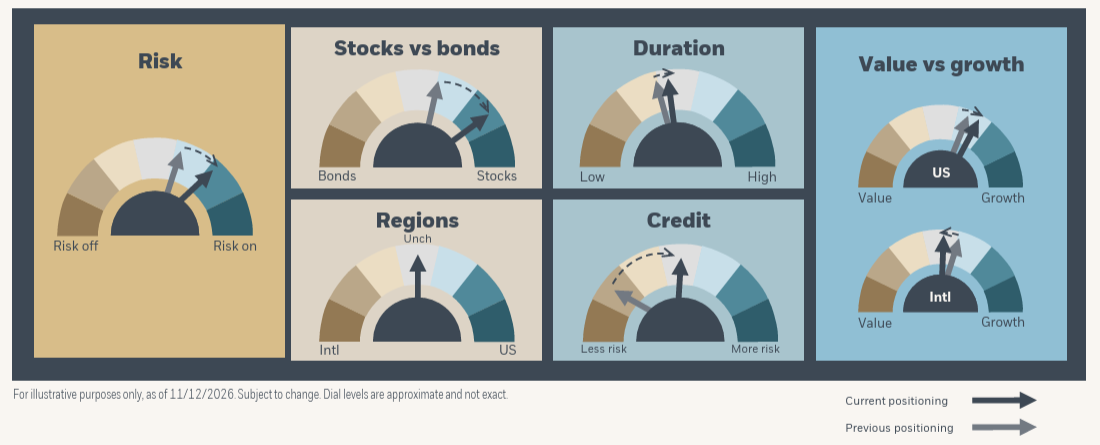
Portfolios at a glance: where we moved the dials
1. A Better Entry Point: Adding to Stocks After the Reset
The mood in markets soured quickly this fall. Investor sentiment toward stocks has fallen to extreme lows, and volatility in the bond market has spiked. Leveraged investors such as hedge funds have pulled back sharply from their most crowded bets.
What has not deteriorated is the economy. October added 165,000 jobs, with upward revisions to the prior two months, unemployment sits at 4.1%, third-quarter productivity grew 3.6%, and the Atlanta Fed's GDPNow model is tracking 3.4% growth for the fourth quarter. Most of this data came in better than expected. In our view, the selloff reflects a shift in sentiment more than a shift in fundamentals.
Corporate earnings tell a similar story. S&P 500 earnings grew roughly 30% this year, and analysts expect about 17% growth next year. Slowing from 30% can sound alarming in a headline, but 17% would still be well above the long-run average of roughly 10%. If those estimates prove approximately right, there is room for solid stock returns even as valuations continue to come down.
Pessimism has historically been a better entry point
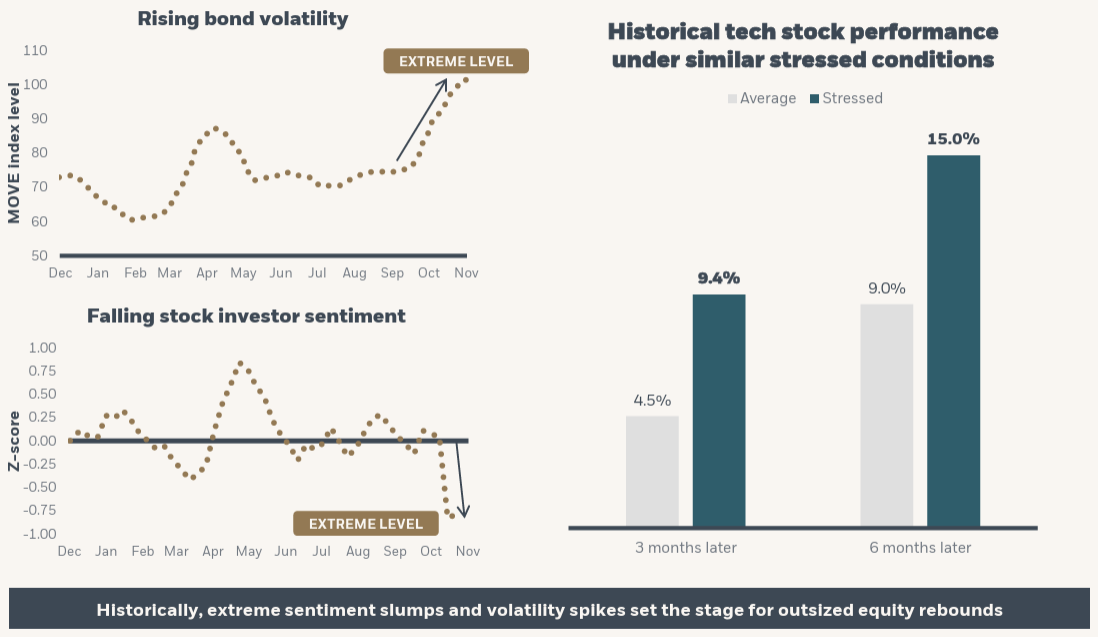
Sources: BlackRock, Bloomberg, as of 11/6/2026. BlackRock analysis covers October 2006 through November 2026, using daily total returns of the Technology Select Sector Total Return Index as a proxy for U.S. technology stocks. A double-sort methodology independently groups historical observations into quintiles based on the preceding 3-month changes in the Morgan Stanley U.S. Equity Sentiment Index (“investor sentiment”) and ICE BofA MOVE Index (“bond market volatility”). Indexes are unmanaged and one cannot invest directly in an index. Past performance does not guarantee future results.
History offers a useful perspective. Since 2006, when investor pessimism and bond market volatility have both reached similar extremes, U.S. technology stocks have gone on to return an average of 9.4% over the following three months, roughly double their typical 4.5%. Over six months, the average was 15.0% versus a typical 9.0%. History never repeats exactly, but it has rewarded investors who stayed engaged when the mood was darkest.
Oil prices and interest rates have also come down from their highs. If energy costs and inflation keep easing, that could go a long way toward restoring investor confidence.
Our Take: We are increasing our equity overweight from 1% to 3%. A 3% out of 5% max overweight is a meaningful lean, but it stops short of the limit, leaving room to add more if the opportunity improves or to pull back if conditions change. With plenty of bad news already reflected in prices, election uncertainty behind us, and our investment signals improving, we see more reason to lean in than to stand still. That does not mean we think volatility is over. Sentiment can always get worse before it gets better, which is why the rest of this rebalance is about where we add risk, not just how much.
2. Keeping the Conviction, Lowering the Octane: Consolidating AI and Defense
We remain believers in artificial intelligence. Demand for computing power is strong, companies have made multiyear investment commitments, and widespread adoption could lift productivity across the economy. Recent worries about limits on data center construction and power supply have cast doubt on the AI buildout, and we think that pessimism goes too far.
But conviction is not the same thing as concentration. AI-linked companies made up about 44% of the S&P 500 a year ago, and they still do today. Over that same year, their share of the index's day-to-day volatility jumped from roughly 50% to 92%.
AI's share of market swings has outgrown its size
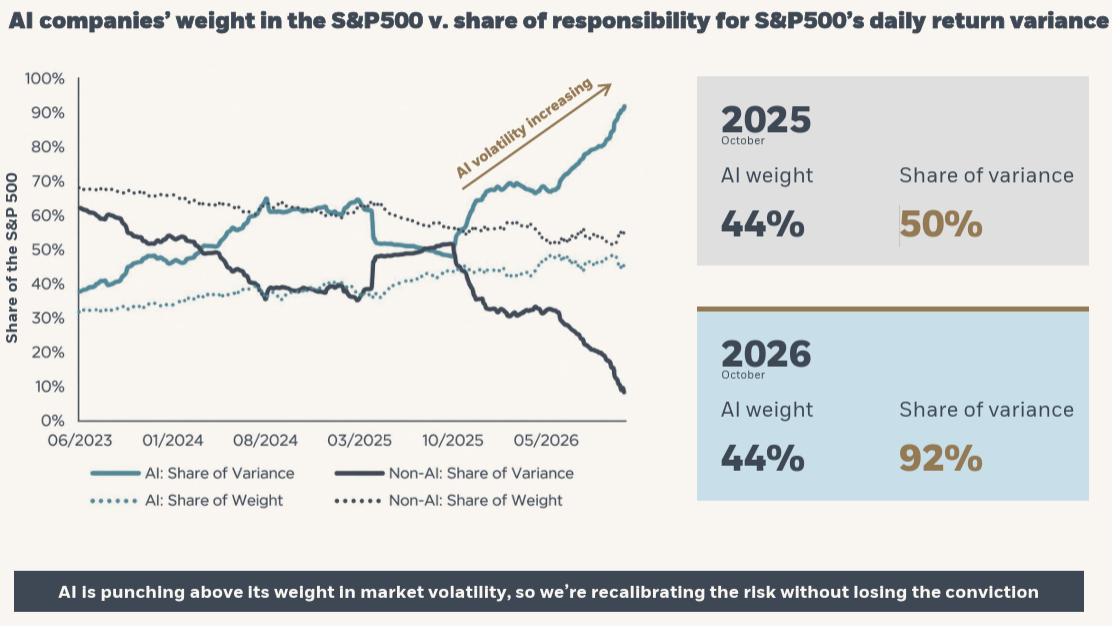
Sources: Bloomberg, Trivariate Research, as of 10/30/2026. Companies in the S&P500 identified with meaningful AI-linked revenues (e.g., semiconductors, memory, cloud, data centers, and model platform, service, and integration providers). Index weight and volatility measurements are approximate as of October 2025 and October 2026. Volatility is measured by each group's contribution to the S&P 500's daily return variance (a measure of fluctuations in index returns), calculated over a rolling 6-month window. Indexes are unmanaged and one cannot invest directly in an index. Past performance does not guarantee future results.
AI exposure is already embedded throughout our broader stock holdings, so our dedicated AI positions were stacking more of the same risk on top. We consolidated portions of our dedicated AI and global defense positions into a more diversified thematic equity strategy. That strategy rotates across a range of long-term growth themes, which keeps us participating in AI and defense while reducing our reliance on their most volatile expressions.
This is about keeping risk in proportion, not abandoning the theme. Volatility in our dedicated AI position has climbed so much that a smaller position today contributes roughly as much risk to the portfolio as a larger one did in the spring. And as of this week, AI and defense rank among the top themes in the diversified strategy we moved into, so our exposure to both remains meaningful.
Our Take: Position sizing is a risk management decision, not a change of heart. We would be happy to see AI keep leading, but we no longer need it to do all the heavy lifting.
3. The Next Rally May Not Be a Rerun of the Last One
One reason we are comfortable spreading our bets is that earnings growth itself is broadening. Early in 2026, the Magnificent 7 (Alphabet, Amazon, Apple, Meta, Microsoft, Nvidia, and Tesla) grew earnings far faster than everyone else: 64% versus 19% in the first quarter. That gap all but closed in the second quarter. For the second half of the year, analysts expect the other 493 companies in the S&P 500 to grow earnings about 10 percentage points faster than the Magnificent 7.
Earnings growth is broadening beyond the giants
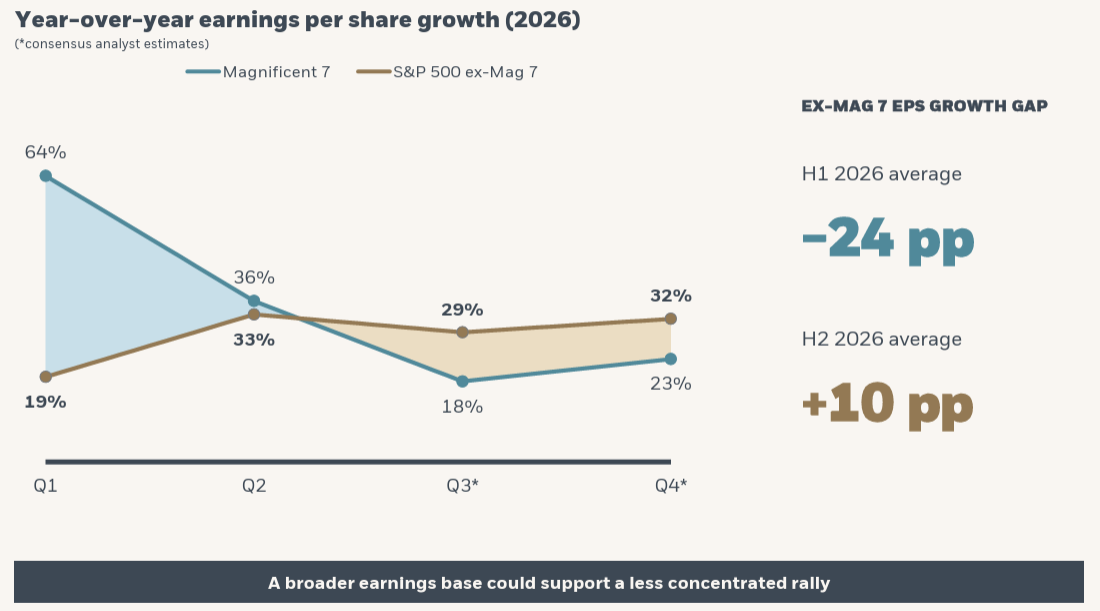
Sources: BlackRock, Bloomberg, as of October 2026. 2026 year-over-year EPS growth. Mag 7: Alphabet, Amazon, Apple, Meta, Microsoft, Nvidia and Tesla; ex-Mag 7: rest of S&P 500. *Q3/Q4 include estimates. Half-year differences are simple quarterly averages (ex-Mag 7 minus Mag 7), in percentage points. Indexes are unmanaged and one cannot invest directly in an index. Past performance does not guarantee future results. Forward-looking estimates may not come to pass. Past performance does not guarantee future results.
We see the same theme outside the U.S. As leadership in global markets shifts, we continue to favor targeted, country-level opportunities over broad regional bets.
Our broad U.S. versus international allocation stays neutral. Earnings trends in the U.S. and abroad have become too mixed to justify a big regional bet. Within U.S. stocks, our earnings-based indicators continue to favor growth over value, so we trimmed value modestly to maintain a slight growth tilt.
Our Take: A broader earnings base could support a less concentrated rally. Owning our highest-conviction themes through a more diversified strategy positions portfolios to participate in that broader leadership rather than depending on a handful of companies.
4. Better Bond Economics: Rebuilding Credit and Extending Duration
Earlier this year, credit spreads were historically tight, meaning investors were barely compensated for lending to companies. We limited credit exposure accordingly. That picture has changed. Over the past year, the 10-year Treasury yield rose from 4.02% to 5.00%, investment-grade corporate bond yields from 4.76% to 5.87%, and high-yield bond yields from 6.57% to 8.21%.
Bonds are paying meaningfully more than a year ago
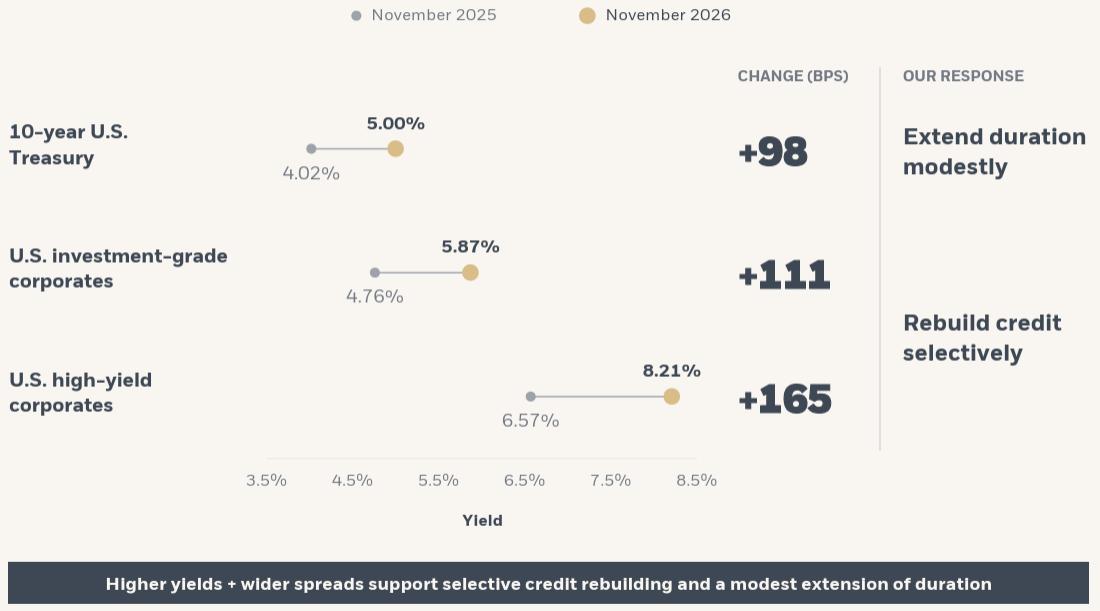
Sources: Bloomberg, as of 11/28/2025 and 11/11/2026. Yields shown for 10-year U.S. Treasury: Bloomberg Generic 10-Year U.S. Treasury; U.S. investment-grade corporates: Bloomberg U.S. Corporate Index; U.S. high-yield corporates: Bloomberg U.S. Corporate High Yield Index. A basis point (bps) is one hundredth of one percent. Example: one basis point = 0.01%. Indexes are unmanaged and one cannot invest directly in an index. Past performance does not guarantee future results
We made three refinements to the bond side of our portfolios:
- Selectively rebuilding credit: In our more bond-heavy portfolios, we are adding credit exposure through an actively managed, systematic bond strategy designed to dial risk up or down as market conditions evolve. This takes us from underweight back to neutral on credit, not overweight. Three months ago, high-yield spreads were tighter than they had been 90% of the time since 2003; today they sit around the 25th percentile. That is more interesting, but we would not call it cheap. Flexibility matters.
- Adding convertible bonds: In our most conservative portfolios, we added convertible bonds, which can capture more of the upside if stocks strengthen.
- Extending duration modestly: Higher yields make longer-term government bonds more attractive, and with some of the economic data that pushed rates higher now cooling, we see some potential for yields to fall. We added longer-duration U.S. Treasuries while keeping overall interest rate sensitivity modestly below our benchmark. The Federal Reserve remains hard to handicap, and inflation risks have not vanished.
Our Take: Bonds are paying meaningfully more than they were a year ago. Higher starting yields give the bond side of a portfolio more income to work with and more room to cushion stocks if growth disappoints.
The Bottom Line: Deliberate, Not Daring
Leaning into discomfort is not bravado. It is recognizing when much of the bad news is already in prices, then adding risk deliberately, in the places where we believe it is best compensated. We are increasing stock exposure, diversifying how we own our highest-conviction themes, and putting better bond yields to work, while staying mindful that volatility may not be finished. As the year winds down, perspective matters too: the last few months have been uncomfortable, but a full-year view tells a steadier story than a four-month one.
At Wrought Financial Planning, the investment portfolio is one part of a broader plan. Our job is to manage the complexity of our clients' financial lives with care, so they can focus on their families, their careers, and the life they want to build.
If you are an entrepreneur, partner, or self-employed professional and you are wondering how your investments fit into the bigger picture, we would welcome a conversation. We start by listening to what matters most to you, then walk you through how we work with clients to build a plan around it.
Schedule a Right Fit Call with Wrought Financial Planning
Disclosures: Wrought Advisors LLC dba Wrought Financial Planning is a fee-only Registered Investment Adviser registered in New Jersey, Pennsylvania, and Delaware. This material is prepared for informational and educational purposes only and should not be construed as personalized investment, legal, or tax advice. Charts are based on third-party data believed to be reliable and are shown for illustrative purposes only. Forward-looking estimates may not come to pass. Indexes are unmanaged and cannot be invested in directly. Past performance is no guarantee of future results. Asset allocation and diversification strategies do not guarantee a profit or protect against loss in declining markets.